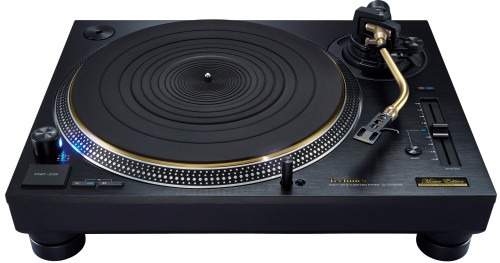


Introducing the SL-1200GR2BS Grand Class GR Turntable
New Motor-Drive System, ΔΣ-Drive (Delta Sigma Drive)
The ΔΣ-Drive is a new system that applies Technics’ expertise in PWM signal processing. In addition to reducing high harmonics, the new drive suppresses vibrations from the motor for smoother, more accurate rotation, ensuring a rich reproduction of the music.
The First Stage of The New Generation of Technics’ Direct Drive Turntables
Coreless Direct Drive Motor Achieving Stable Rotation
In 1970, Technics commercialised the world‘s first direct-drive turntable, and the system took the world by storm. Unlike belt drive and other systems, direct drive systems rotate the motor at low speed and directly drive the platter, thus providing numerous advantages, such as the almost complete absence of degradation in S/N ratio due to motor vibration and deceleration mechanisms, as well as high reliability over a long period of time because of not requiring parts replacement.
And in 2016, Technics developed the twin-rotor, surface-facing, coreless direct drive motor with rotor magnets placed on both sides, thereby eliminating the rotation irregularity of the motor, referred to as "cogging," which was a unique issue for direct drive systems. This motor was adopted for the SL-1200G, which once again drew a significant response in the hi-fi market. The SL-1200GR2BS inherits the same design philosophy with the new development of a single-rotor, surface-facing, coreless direct-drive motor, resulting in the elimination of cogging.
Multi-Stage Silent Power Supply
Use of a high-speed switching power supply ensures a stable supply capacity and less ripple and humming. Applying a switching power supply to a turntable eliminates the need for a large transformer and countermeasures for the ensuing mechanical vibrations.
A switching frequency of above 100 kHz limits the impact of noise on the music playback bandwidth.
Current Injection Active Noise Cancelling
This technology combines a noise detection device with an error amplifier. It detects residual noise in the power supply and applies an inverse phase current to remove noise components. It removes low-frequency noise more effectively than a regulator to ensure a more ideal power supply.
Pursuing Rigidity and Vibration Damping Characteristics
To increase the inertial mass and reduce vibration, the shape of the aluminium die-cast portion was optimised by simulation. At 2.5 kg (including the rubber mat), the SL-1200GR2BS platter is 0.8 kg heavier than that of the previous SL-1200MK5. Also, the back surface of the platter has strengthening ribs added to improve rigidity. Increasing the surface area of contact with the deadening rubber achieves damping characteristics that are more than twice those of the SL-1200MK5.
Tonearm: Achieving High Initial-Motion Sensitivity
With its gimbal suspension construction, the tonearm bearing section uses a cut-processed housing that employs high-precision bearings, as in the SL-1200G and SL-1200GR. The high initial-motion sensitivity of 5 mg or less is achieved through manual assembly and adjustment by skilled Japanese artisans. This enables the grooves etched into the records to be accurately traced.
In addition, one type of auxiliary weight comes included, and the cartridge can be swapped with a variety of other cartridges to match the music genre or feeling. (Applicable cartridge weight when using the supplied auxiliary weight: 10 - 16.4 g (not including the supplied headshell))
PRODUCT FEATURES
- A coreless direct-drive motor achieving stable rotation
- ΔΣ-Drive suppresses vibrations from the motor for smoother, more accurate rotation
- A low-noise, low-voltage power circuit and a switching power supply
- Two-layer platter with high rigidity and vibration damping
- Tonearm achieving high initial-motion sensitivity
- High-rigidity body and high-damping silicon insulators for smooth sound and isolation from various vibrations
Technical Specifications
Turntable Section
DRIVE METHOD
Direct Drive
MOTOR
Brushless DC motor
TURNTABLE SPEEDS
33-1/3, 45 and 78 rpm
PITCH ADJUSTMENT RANGE
±8% and ±16%
STARTING TORQUE
2.2 kg・cm
BUILD-UP CHARACTERISTICS
0.7 s. from standstill to 33-1/3 rpm
BRAKING SYSTEM
Electronic brake
WOW AND FLUTTER
0.025% W.R.M.S.
TURNTABLE PLATTER
Aluminium diecast
Diameter: 332 mm
Weight: Approx. 2.5 kg (including rubber sheet)
Tonearm Section
TYPE
Static Balance
EFFECTIVE LENGTH
230 mm
OVERHANG
15 mm
TRACKING ERROR ANGLE
Within 2° 32' (at the outer groove of 30 cm (12") record)
Within 0° 32' (at the inner groove of 30 cm (12") record)
OFFSET ANGLE
22°
ARM HEIGHT ADJUSTMENT RANGE
0–6 mm
STYLUS PRESSURE ADJUSTMENT RANGE
0–4 g (Direct Reading)
HEADSHELL WEIGHT
Approx. 7.6 g
APPLICABLE CARTRIDGE WEIGHT RANGE
Without auxiliary weight:
5.6–12.0 g
3.1–9.5 g (using cartridge spacer)
14.3–20.7 g (including headshell)
With auxiliary weight:
10.0–16.4 g
7.5–13.9 g (using cartridge spacer)
18.7–25.1 g (including headshell)
CARTRIDGE MOUNTING DIMENSION
12.7 mm (1/2") interval
HEADSHELL TERMINAL LUG
1.2 mmφ 4-pin terminal lug
Terminals
AUDIO OUTPUT
PHONO (Pin Jack) × 1
EARTH TERMINAL × 1
GENERAL
POWER SUPPLY
AC 220–240 V, 50/60 Hz
POWER CONSUMPTION
11 W (Power ON)
0.3 W (Power OFF)
DIMENSIONS (W × H × D)
453 × 173 × 372 mm
WEIGHT
Approx. 11.5 kg
OPERATING TEMPERATURE RANGE
0°C to +40°C
OPERATING HUMIDITY RANGE
35% to 80% RH (no condensation)
Included Accessories
Turntable
Turntable sheet
Dust cover
EP record adaptor
Balance weight
Auxiliary weight
Cartridge spacer
Headshell
Overhang gauge
Screw set for cartridge
PHONO cable
PHONO earth lead
AC power supply cord
Owner's Manual
*This information has been obtained from Manufacturers website. We advise that Features, Specifications & Price are subject change without notice.
E&OE